Why Vietnamese Coffee Has Taken Over American Café Culture
Vietnamese coffee has arrived. If you’ve walked into an independent coffee shop recently, you’ve probably noticed something on the menu that wasn’t there five years ago. Between the oat milk lattes and the cold brews, there’s a new regular: cà phê sữa đá. Vietnamese iced coffee. And it’s not just a trend. It’s a takeover.
From Brooklyn to Los Angeles, Vietnamese coffee has moved from ethnic grocery store shelves to the center of American café culture. Specialty coffee shops are building entire menus around it. Food media can’t stop writing about it. Home baristas are ordering phin filters by the thousands. Something real is happening here — and it goes deeper than taste.
What Actually Makes Vietnamese Coffee Different From Everything Else
Before getting into the why, it helps to understand the what.
Vietnamese coffee is built on two things that set it apart from the espresso drinks most Americans grew up with: Robusta beans and sweetened condensed milk.
The beans: Most Western coffee — your Starbucks, your specialty third-wave roasts — is made with Arabica beans, prized for their smooth, nuanced, often fruity flavor profile. Vietnamese coffee traditionally uses Robusta, a hardier bean with nearly twice the caffeine content and a bolder, more bitter, earthier taste. Robusta was cheaper to grow in Vietnam’s climate, which is why it became the foundation of Vietnamese coffee culture. The result is a brew that hits harder and tastes darker than most Americans are used to.
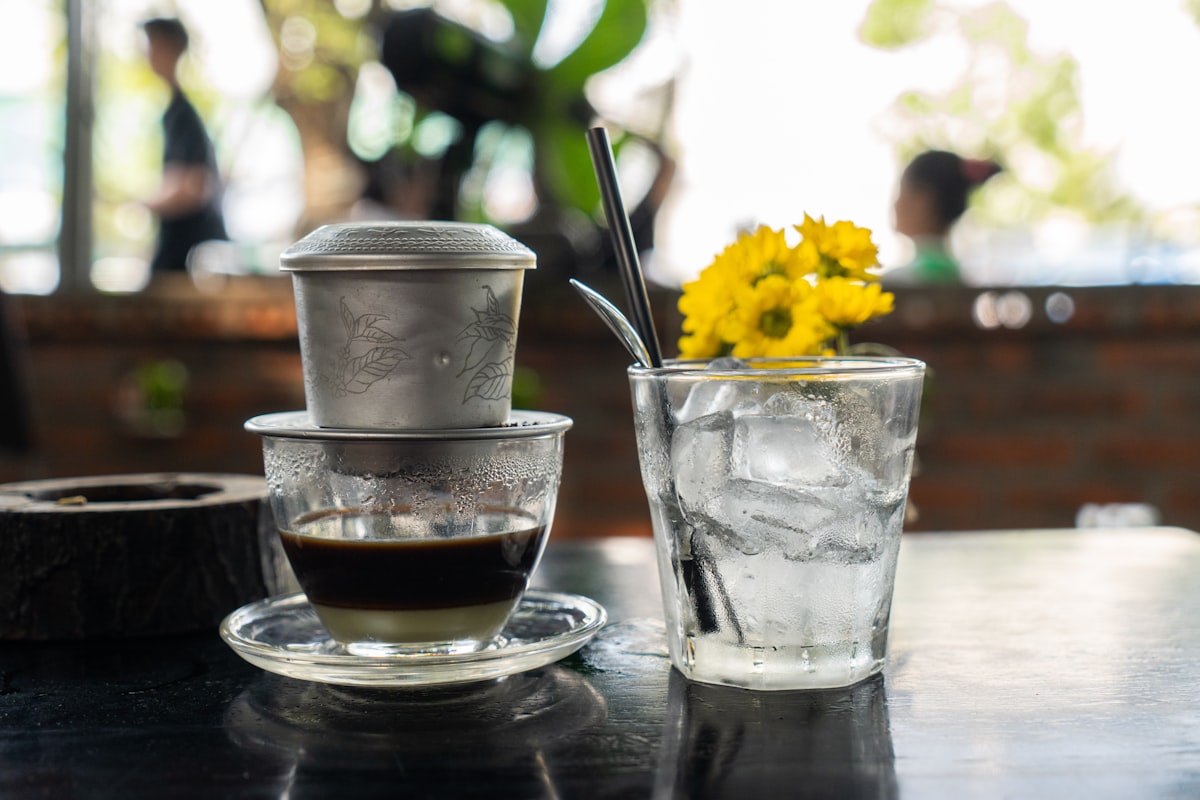
The filter: Vietnamese coffee is brewed using a phin, a small metal drip filter that sits directly over your cup and takes three to five minutes to brew a single serving. It’s slow, intentional, and produces a concentrated, syrupy coffee that’s closer to espresso in strength but different in character.
The milk: Sweetened condensed milk became part of Vietnamese coffee culture during the French colonial period, when fresh milk was scarce and expensive. The thick, sweet substitute transformed what could have been an undrinkably bitter cup into something rich and deeply satisfying. Pour that over ice and you have cà phê sữa đá — arguably the most refreshing coffee drink in existence.
A Brief History Worth Knowing
Coffee arrived in Vietnam via French colonizers in the mid-1800s. The French planted Arabica in the Central Highlands, but Robusta eventually dominated because it was more resistant to disease and easier to cultivate at lower altitudes.
By the mid-20th century, Vietnam had developed its own distinct coffee culture — one built around slow mornings, small metal filters, and sweet condensed milk. Coffee shops became social anchors in Vietnamese cities, places where you sat for hours, not minutes.
When Vietnamese refugees arrived in the United States after 1975, they brought that culture with them. Vietnamese coffee became a fixture in Vietnamese American communities — available at pho shops, Asian grocery stores, and the homes of anyone who had learned to make it growing up. For decades, it was largely invisible to mainstream American food culture.
That’s changing fast.
Why It’s Exploding Right Now
Several forces converged to bring Vietnamese coffee from community staple to cultural moment.
The third-wave coffee movement created the conditions. As American coffee culture became increasingly focused on origin, process, and flavor complexity over the past decade, drinkers became more curious and adventurous. The audience for Vietnamese coffee — people interested in something different, something with a story — was already being built.
TikTok did the rest. Videos of phin filters slowly dripping over glasses of ice, of condensed milk swirling into dark coffee, of the first satisfying stir — they’re mesmerizing to watch and incredibly shareable. Vietnamese coffee became one of the platform’s food obsessions, introducing millions of people to something they’d never tried and making it feel accessible and cool simultaneously.
Vietnamese American chefs and entrepreneurs stepped forward. Figures like Andrea Nguyen, who has written extensively about Vietnamese food, and a wave of Vietnamese American café owners across the country began telling the full story of Vietnamese coffee — its history, its craft, its cultural weight. That context made the drink more interesting, not less.
The coconut coffee moment. Cà phê cốt dừa — Vietnamese coffee blended with coconut milk or coconut cream — became a viral sensation in its own right. Lighter, creamier, and intensely tropical, it introduced Vietnamese coffee to people who don’t even like traditional coffee. Starbucks took notice. So did every independent café trying to stay relevant.
What It Means for Vietnamese Americans
For many Vietnamese Americans, watching their family’s morning ritual become a cultural phenomenon is complicated — in the best possible way.
There’s something genuinely meaningful about seeing a drink your grandmother made every morning, that your parents sought out at specific shops in specific neighborhoods, suddenly appear on a chalkboard menu in a coffee shop run by someone with no connection to Vietnam. It’s recognition. It’s the mainstream catching up.
It also creates an opportunity. Vietnamese American café owners and entrepreneurs are well-positioned to tell this story with more depth and authenticity than anyone else — and many are doing exactly that. Cafés like Nguyen Coffee Supply, founded by Sahra Nguyen in New York, have built entire businesses around sourcing directly from Vietnamese farmers, educating customers about Robusta, and centering the Vietnamese American perspective on their own culinary heritage.
That’s what a food trend looks like when the community it belongs to is in the driver’s seat.
How to Make It at Home
You don’t need to go to a café to experience Vietnamese coffee at its best. The equipment is inexpensive and the process is simple.
What you need:
- A phin filter (available on Amazon or at any Asian grocery store for $5–10)
- Vietnamese ground coffee (Trung Nguyên and Café Du Monde are the most widely available; Nguyen Coffee Supply if you want something premium and single-origin)
- Sweetened condensed milk (Longevity Brand is the classic choice)
- Ice
The process:
- Add one to two teaspoons of sweetened condensed milk to the bottom of your glass
- Place the phin filter on top of the glass, add two tablespoons of ground coffee, and press down gently with the filter press
- Pour a small amount of hot water (just off the boil) over the grounds and wait 30 seconds for the coffee to bloom
- Fill the filter with hot water and place the lid on top
- Wait three to five minutes while the coffee drips through
- Remove the filter, stir the coffee and condensed milk together, pour over ice
The result is something no espresso machine produces — thick, sweet, bitter, and cold in a way that tastes like it was invented specifically for summer.
The Bigger Picture
Vietnamese coffee’s rise is part of a broader shift in American food culture — one where Asian culinary traditions are being recognized not as exotic curiosities but as sophisticated, historically rich, and deeply worth understanding on their own terms.
It took a long time. But the phin filter is on the menu now, the condensed milk is in the refrigerator section at Whole Foods, and the story of how a small metal drip filter became an American obsession is finally being told in full.
Your grandmother knew what she was doing.
The cultural significance of Vietnamese coffee extends well beyond the cup — it reflects a history of French colonialism, wartime adaptation, and immigrant entrepreneurship. Read more: PBS Food on Vietnamese coffee culture.
Frequently Asked Questions
What makes Vietnamese coffee different from regular coffee?
Vietnamese coffee uses robusta beans instead of arabica, producing a stronger, more bitter, higher-caffeine brew. It is traditionally brewed through a phin filter — a small metal drip device — and served over ice with sweetened condensed milk, creating cà phê sữa đá.
Why has Vietnamese coffee become popular in American cafés?
Vietnamese coffee has taken off in American cafés because it offers something genuinely different: a sweeter, stronger, more intense cold coffee experience at a time when cold brew and iced lattes dominate menus. Its dramatic appearance and distinct flavor make it highly shareable on social media.
Where did Vietnamese coffee culture come from?
Vietnamese coffee culture developed during the French colonial period, when French colonizers introduced coffee cultivation to Vietnam. Because arabica was difficult to grow in the Vietnamese climate, robusta became the dominant bean, and the distinctive brewing and serving style evolved from there.
What is cà phê sữa đá?
Cà phê sữa đá is Vietnamese iced coffee — strong robusta coffee brewed through a phin filter, mixed with sweetened condensed milk, and poured over ice. The name translates literally to “coffee with milk and ice.” It is the most widely known Vietnamese coffee drink.